
Typology
Article
Scopes
Governance
This November marks fifty years since Franco died. And I read that 20% of the population believes people lived better under him. It unsettles me to see that we live in a world that sometimes seems more extreme, racist and sexist (and I emphasise: seems), but it is also likely because we lack the confidence and living conditions needed to decide together.
The dictatorship imposed a single voice, fear and submission, and perhaps we still carry that trauma: when we are tired, frustrated or hopeless, it is easy to think, “someone tell me what to do.” I fall into it too, sometimes. Letting yourself be led can feel like a kind of rest.
The problem is when that rest becomes dependence, when it takes root in our culture. It is not easy in the context we live in, where the living conditions of most people are precarious and centres of power are almost inaccessible. There is a structural violence that is difficult for most of society to transcend: labour precarity, chronic poverty, impossible rents, voting systems that exclude migrant neighbours, bureaucracies that block access to rights, institutions that make decisions without listening, women doing double shifts without recognition, the invisibilisation of care work, pollution, factory farms or extractive projects imposed on local regions, the loss of essential services, difficulty accessing land, institutional abandonment of rural territories, forced isolation and the lack of meeting spaces or mutual support, among others.
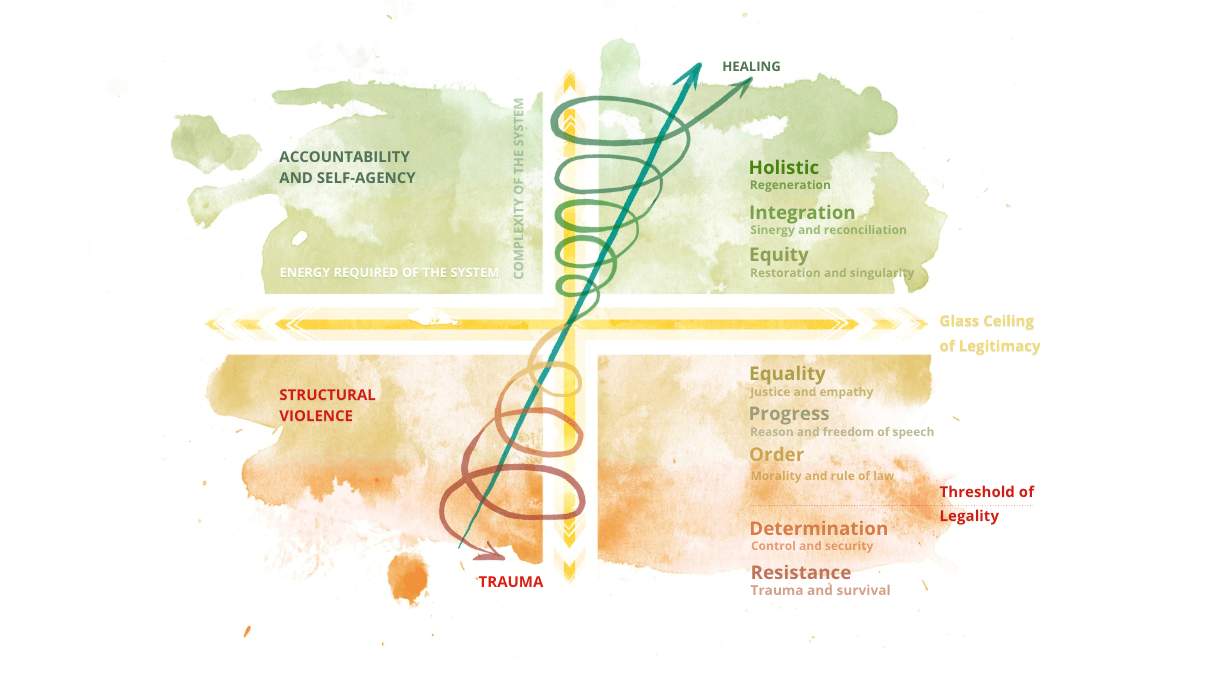
The Regenerative Spiral shows how systems evolve from trauma towards healing. At its base lie fear, authoritarianism and the need for control. And as we raise the system’s energy, we learn to distribute power and recognise interdependence.
When I participate in spaces where decision-making is shared —in the cooperative, in a mutual aid network, in organising a neighbourhood festival— that spark of trust and hope reignites, and I feel that we are regenerating something deeper than democracy.
Where there is care and listening, potential flourishes with greater vitality. Where a shared purpose vibrates beyond ourselves; where each person’s diversity can express itself unconditionally as part of a greater whole.
Perhaps this is the next step emerging in our time: a more open and community-based governance that is gaining momentum —seen in the growth of social and solidarity economy initiatives, cooperatives, village councils, energy communities…—, provoking palpable resistance from those who hold the power —for example, in the expression of a far right with an expiration date—, but inviting us to learn to listen, to hold disagreement and to reconcile our personal, social and ecological dimensions.
We are at this point of inflection, a polarity between exhaustion and hope. Between “someone decide for me” and “let’s decide together how we want to live.” And perhaps, just perhaps, this is already the beginning of healing.
Laura Comas, from Resilience.Earth SCCL.
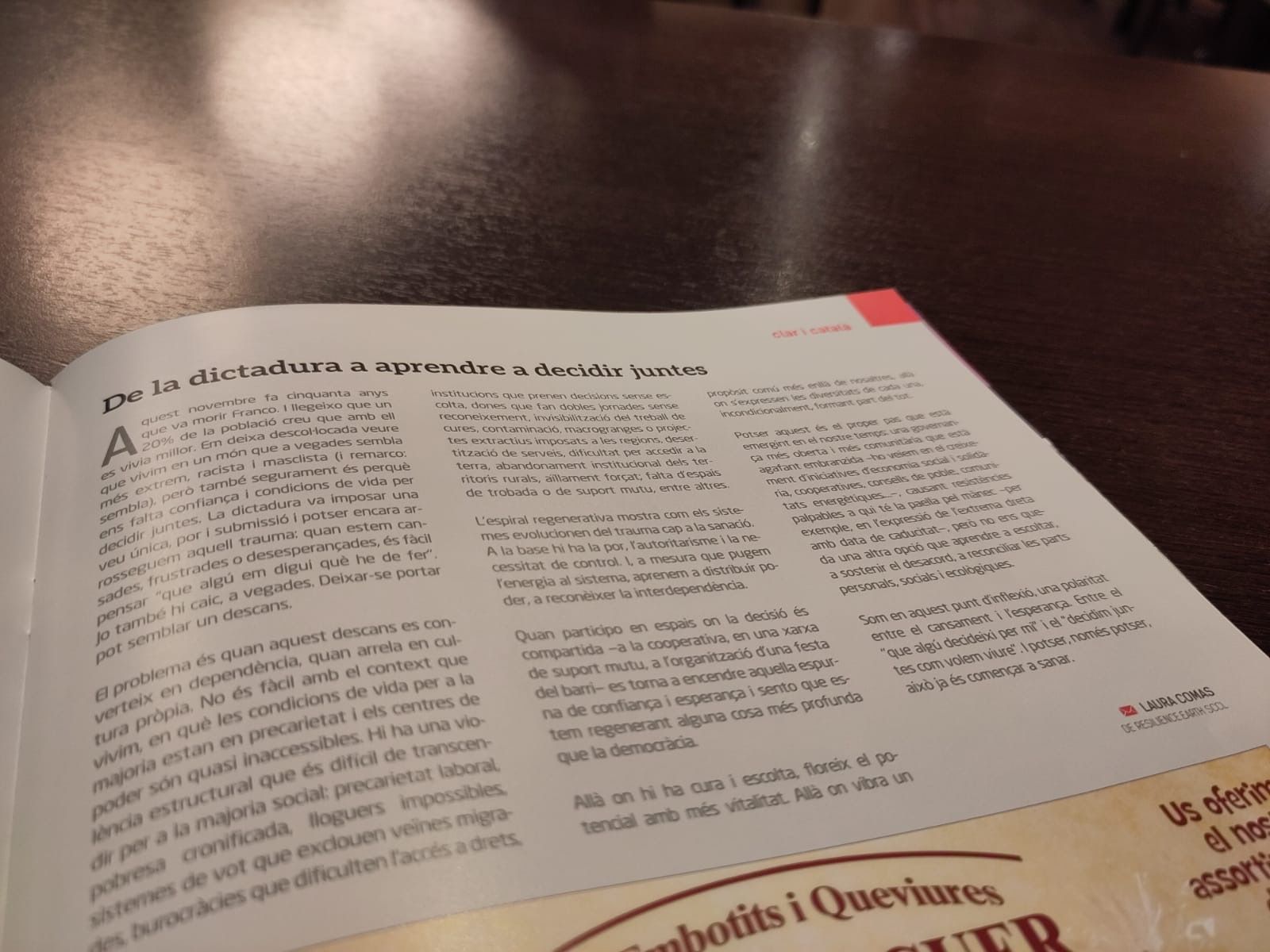
Published in the weekly print edition of La Comarca d’Olot, issue 2,295, on November 20th, 2025.