




Typology
Article
Scopes
Governance, Agrofood, Economy
“Proximity is not a new banner; it is a way of living.”
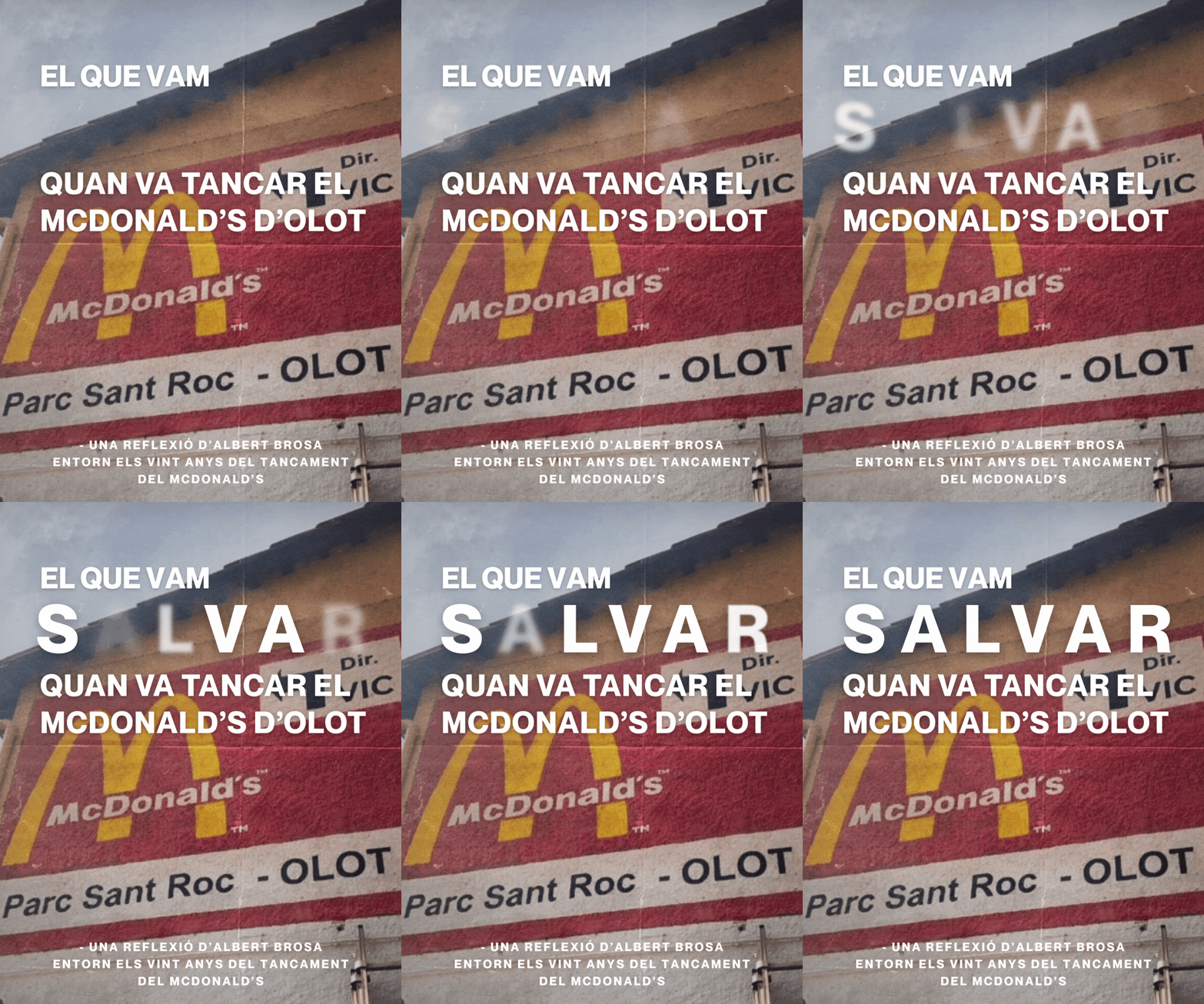
Twenty years ago in Olot, the closure of the McDonald’s did not go unnoticed. It was a loud, intense episode, deeply felt by part of the local community. There were popular barbecues, gatherings, banners, debates, and a mobilisation that went far beyond the county. That confrontation was not so much about the arrival of a fast-food restaurant —although that too— but about defending a local model, a way of understanding food, land, and territory that was incompatible with an industrial, globalised format. Behind the humour of the protests there was conviction, and over the years we’ve realised there was also a sharp intuition: La Garrotxa had a strong enough ecosystem of its own to question a model that never really took root.
That episode reminded us that the territory had— and still has— an economic and food structure deeply rooted in the landscape. A model based on local producers, family farms, artisan makers and establishments that, more than selling food, offer cultural continuity. “Proximity” is not a new slogan; it is a way of living that many regions have practised naturally for decades. Local consumption activates a virtuous economic, social, and environmental circle that is increasingly necessary —I would say indispensable.
This model is not anecdotal. In Catalonia there are around 56,000 farms registered in the Agricultural Holdings Register, and thousands of them work under proximity criteria or within short food-supply chains regulated by the Government. The growth of direct sales and sales with a single intermediary, supported by the proximity-sales decree, has consolidated a system that is more traceable, fairer, and more connected to consumers. When we buy local products, we’re not only buying quality: we are helping maintain economic activity in the territory, because the income tends to stay there. Farmers hire local people and services; those generate work; the workers, in turn, consume locally… it is real circular economy, not rhetoric.
This commitment is especially important at a time when rural Catalonia is experiencing a profound transformation. In the last three decades, Catalonia has lost more than 40% of its family farms; 52% of farmers are over 55, and only 6% are under 35; and seven out of ten farms have no guaranteed generational replacement. In La Garrotxa, the data follow a very similar trend: farms are becoming larger but fewer, and their dependence on external markets is increasing —unless a shift in local consumption ensures the sector’s viability. This scenario shows that defending local products is not just a gastronomic choice; it is a structural necessity.
Supporting the territory means understanding that every purchase is an economic and political gesture. When we feed large fast-food multinationals operating with raw materials of often distant origin, industrialised processes and low wages, the territory receives nothing in return. Profits leave and generate no local economic activity. In contrast, when we buy from local farmers, livestock breeders, artisans or small shops, we help sustain families, trades, and an economy that keeps the landscape alive. It is a difference that too often goes unnoticed in daily life.
Seen in perspective, the closure of the McDonald’s is no longer just the chronicle of a commercial or cultural disagreement. It is a reminder of what happens when a territory decides what it wants to be. “Proximity” cannot become gastronomic folklore that we invoke only when there is a conflict or when we remember a symbolic victory. If we want to preserve a territory that is alive, productive and coherent with itself, we must defend it every day: buying locally, valuing the people who make food production possible, recognising that food is identity —and that identity also needs protection.
Twenty years ago, Olot and La Garrotxa raised their voices, and that call must resonate even more today. The best tribute we can pay is not to idealise that moment, but to give it continuity. We don’t need to wait for another conflict to defend local producers. The regeneration of the territory depends on constancy, not on occasional battles. And it is this constancy —a daily, discreet, persistent choice— that can ensure that the future of La Garrotxa, and of any region, remains a future that is rooted, alive and dignified.
A reflection by Albert Brosa, member of Resilience.Earth, Olot, December 2025.